
Blood
Chapter Four
Fiction from me as we head toward Halloween. I’ll post one chapter every Friday at 9pm.
This is Chapter Four.
Previously, Chapter Three.
To start from the beginning — Blood: Chapter One.
Blood
IV.
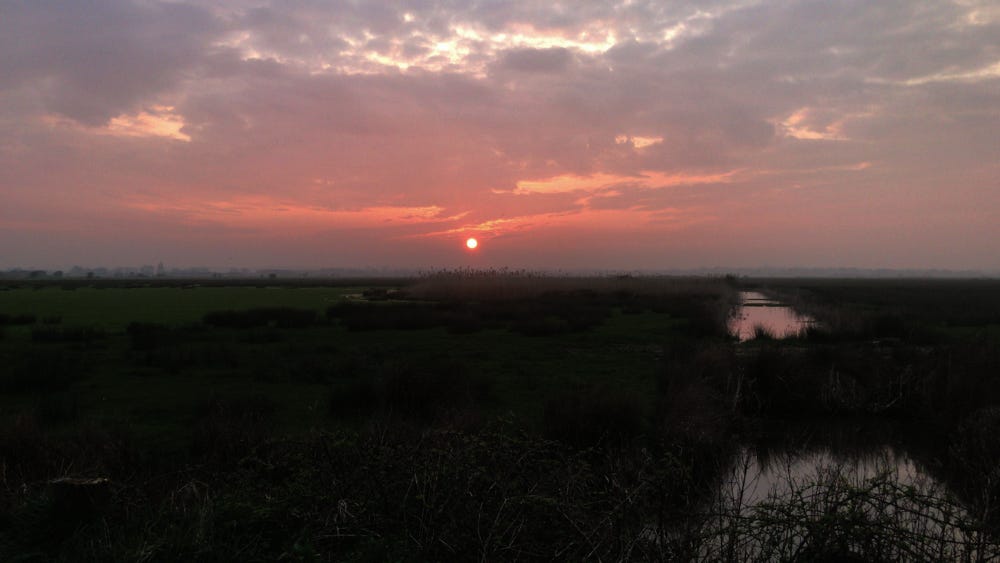
Jake fiddled with a cord tied around his left wrist. He was in the countryside again, walking and leaping with some difficulty across a flat grey-green landscape scored with waterways and dotted with soft knolls. It was getting dark, making the sky even more enormous and oppressive over the flat, encircling horizon. There were none of Jake’s beloved pylons to be seen, but the sparse, gnarled, grandfatherly trees seemed to form their own inscrutable networks, as if connected in vast filaments by invisible cables in the air.
He was following an older boy — older, but nowhere near as old as Matthew’s brother — who was wearing a heavy knapsack, yet still bounding around. The older boy gave the impression, very much unlike Jake, of being stronger than almost everything in his immediate surroundings. He clearly knew very well where he was going and what he was doing, and Jake struggled to keep up: the older boy sometimes went too fast, or took leaps that were longer than Jake could manage in one go. Often enough, Jake found himself distracted by something, just for a second, but then looked up to see that the older boy was somehow ten or twenty yards in the distance.
They must have been near a road, as three or four cars hummed past, somewhere behind them, when the older boy suddenly decided it was time to sit and rest for a while. Jake was becoming ever more concerned that the light was fading, and the older boy was not putting him at ease, despite his confidence and his self-assurance. The older boy pulled some bread from his bag and tore a chunk off. He ate vigorously, and spoke with his mouth full.
‘Blood’s called blood before you bleed. What do you call tears before you cry?’
The older boy was not pondering aloud: this was a confidently-delivered puzzle. Jake didn’t answer him — not because he thought the riddle meant nothing, but because he was anxious that he was being asked a trick question. He did find himself looking around at the landscape, and absently he observed: ‘It must have grown across a scar.’
‘Every second ago,’ said the older boy. ‘In case it overflowed!’ and he leapt up — excitedly, as if keen to show Jake that he didn’t know the half of it — and quickly selected two good-sized twigs, or rather sticks, from the ground, each as long as a ruler, before handing one to him. Then they walked together, through some trees, and down a shallow bank thick with brambles, to a small but strongly-flowing brook, and the older boy explained what they were going to play.
The game was almost identical to Poohsticks, except that before dropping anything into the river — and the older boy began to demonstrate for him — you had to firm up a slick of mucus in your mouth, and deposit it along the length of your stick by licking it from end to end. It was called Helterwash, and just like Poohsticks, it had originated at an actual bridge: this one. The bridge was barely a bridge — it seemed to be made from two planks fixed together and laid flat, over what was in any case barely a river. Jake believed that he could easily have jumped across it; he also believed that it would be dangerous to try. Painstakingly he covered his stick in spit, and the rough textures of lichen and bark glanced on his tongue.
The older boy wrapped a strong arm around Jake’s shoulders as they looked up-river, and Jake saw that he had a tattoo of a constellation. The older boy turned him around, so that they both faced downstream. ‘You know there’ll be hell to pay if you go all the way down, as far as the marsh…’
Jake felt a rush of terror. He hadn’t gone as far as the marsh, he wanted to insist, he hadn’t done that. I didn’t do that.
The older boy pointed far downriver: ‘There, see.’
Jake looked, and saw nothing there.
‘That’s Cutlass Waller.’
Jake saw nobody there.
‘He hates it here that much, he’d kill you for bringing him.’
Jake hadn’t stopped staring downriver. There was nobody there. The older boy was disturbed, but shook his fear away. ‘We’ll do this anyway.’
So they turned around, and faced up-river again. After counting to three together, both boys let go of their sticks. They dropped simultaneously into the water; their falls were precisely the same, even the splashes identical. Jake spun back round as fast as he could. The river, a little deeper and more intense now, was flowing fast. Anything floating on it should have appeared on the other side of the tiny bridge in a second, but nothing did. Jake didn’t know whether the sticks had vanished, or whether they were ten feet downriver already. The sky was balefully different, greyer and more cruel, the trees closer and darker. The older boy had vanished to thin air the moment Jake ducked round and out from his arm. Now, he felt cold, he was completely alone. He wondered where everyone was, and why he was there.
As if in answer to the question he hadn’t voiced — first, they were gone, they were nowhere; second, he had no friends, they were never real — he felt a slick of warm liquid run from his nose down over his lip, and a drop of blood landed with a gentle tock in the river. Into a large and quickly-widening circle beneath the surface an image formed itself in deep red, with a wide streak of bony white curving across it like a fanfare of violent teeth.
In this image, something alive of the landscape was silently screaming at Jake, and he knew that it meant to kill him. He heard someone breathe out, just inches behind his head, and for a moment he froze. Then he jumped feet first into the river.
Jake was wide awake. Completely awake, immediately, and terrified. The thought that had torn him from sleep was that it was too late, that he was going to die — now, he knew he was alive, but he still believed that something was going to harm him. His feet were freezing cold. He wriggled his toes to check they weren’t wet. They weren’t.
In the enveloping dark he grabbed the duvet with his feet, and clumsily tried to pull it back down over them. This did nothing other than to yank the duvet down from his neck, leaving his chest uncovered. This hadn’t been the situation before. He tried again, and the same thing happened. The heavy grey woollen blanket was simply gone. He could not bear to leave his feet sticking out; also, he wanted to be able to snuggle up with the duvet almost to his face. This was horrible. This was the opposite, he thought, of that thing people said about a problem being like a carpet too big for a room. This was a duvet too short for him, and he was not even very tall.
He did all that he could do, which was to curl up as small as he could and try, desperately try, to remain under the duvet. He was so exhausted that an unhappy feeling echoed, met, and joined with his current problem. Perhaps if people took their games more slowly, he thought, he would find them a little less mean-spirited. Perhaps if the duvet was longer, his feet wouldn’t be cold. The duvet wouldn’t ever be longer and people wouldn’t ever take their games more slowly. The two ideas took on the same sad shape, then melted apart again into something else.
As scrambled as his thoughts were, some of them very nearly dreams, it took forever to fall asleep again. Jake was uncomfortable, and completely miserable. As much as he wanted to deny it, he was still scared. Something had wanted to harm him, and now his feet were exposed, and a blanket had vanished.
His third dream arrived deep in the night, and placed him among banks of reeds.
There were some distant trees. It was night in the dream, too. He heard a gentle breeze, and insects. His feet creaked; he was on a very small bridge, a familiar bridge, and stretching into the distance before him in shrill moonlight was an empty riverbed. It was as if he’d never woken — he hadn’t moved — except that the water was gone. He’d never seen an empty river. For a short while he did nothing; he simply stood silent and still, listening for anyone else. There was no-one.
He looked straight down, and saw that a patch of the bed was stained dark with a residue of dry blood. He recognized it as the image he had seen before, the one that felt like a scream, but it looked now flat, atrophied, dead, as if only a depth of water gave it form and power. Where its white streak had been there were some grey rocks. Carefully he clambered down from the low bridge, first sitting on it — so that his swinging feet were almost on the riverbed already — and then gently pushed himself off.
He landed with a soft crunch and crouched down, for a better look. The red which formed the image appeared, on twigs and leaves, like a kind of rusty mildew. But it was on the dry mud too, and not just on its surface; it seemed to be its colour, rather than just a dust on top. The row of stones, indistinct in the moonlight, were on closer inspection teeth. Human teeth, yet too big for any human. Each was a little larger than the end-part of his thumb. They looked rotten, pitted with dents and holes, and were ridged with black streaks. He went to pick one up.
Immediately he thought, not that one. So he hovered for half a second over another, before tentatively pulling at it. It seemed very slightly to resist, to pull back as if attached to something, but all of a sudden it gave way and came loose. He gasped at a sharp stab, deep inside his nose. Alert, and worried, he stood up again and noticed the moonlight illuminating a bank of nettles; it was revelatory, it was as if they had turned from dead to alive, or even as if they had never been there before. He remembered the thin nervy threads by which alone his milk teeth had been attached, in their final hours, and remembered how painful they sometimes were — and he remembered how much they bled if ever that thread was snapped. True enough, on the riverbed, into the rusty red of the image, from where he had plucked its tooth, began to trickle blood.
Quicker than he knew what he was doing, he tried to bite into the tooth: his instinct was that it ought to contain a reservoir, and that reservoir would contain — yes! — brandy — which absolutely was good for you, wasn’t it; those wonderful big dogs used to carry it in barrels for explorers — or maybe it would be rum. Pirates would have drunk rum, in emergencies.
He could not bite into the tooth. The hardness he encountered hurt him. He nearly dropped it — and in nearly dropping it, he looked at his feet. They were wet. The riverbed was bleeding, profusely — startled, he stepped backward with an audible splash — and of course it was; he had ripped a tooth from it. Only, it wasn’t blood. At least it seemed not to be blood. It was water; it was clear water. Certainly, while it had flooded only over the deep red of the image, it had appeared in the moonlight to be blood. But now, the entire river was filling with water.
It rose faster than he had ever believed water could rise. It was very soon up to his knees. He panicked; he raised the tooth to his face again but this time opened his mouth as wide as he could and placed the tooth right into the deepest, leftmost corner of his jaws — and he crunched. It worked. The horrible tooth broke open, and as it broke open, there was a stench in his mouth of pure decay — it made him retch, he had never tasted something so foul — and out onto his tongue flooded its watery contents. The sudden salinity of it was a shock, and he retched again. This was not brandy, this was sea-water. If it was not sea-water, perhaps it was tears.
Whatever it was, in his mouth was salt-water, and all around him — up to his waist now, gaining an inch a second — was fresh-water. Now, with a few feet of water above it, the image on the riverbed was vibrant and vital again. It was missing a tooth, it was furious, and the vicious hatred of the landscape — of this violently angry ridge or scar — was compressed into it. He couldn’t move. The idea of everything seemed to fuse violently into a single grain: the knowledge, the certainty, that he was dying. Drowning. The water went over his mouth, he began to choke, and something grabbed hold of his ankles.
That single grain split open into a surge of desire, as the torrent furious now splashed into his eyes and ears, and Jake felt different, as if he was a different person — he simply let himself fall, backwards into the water — he knew the older boy was Sorrel, he wished that Sorrel was there — it was a rope around his ankles, he felt it tightening — he wanted to see the stars from a ship, he wanted adventure, piracy, he wanted to be on deck! — and he wanted to be without his soaking clothes, climbing up to the crow’s nest, he wanted the water to be far below him, and for himself to be warm above it — more than anything he yearned for the stars because somehow via those stars he could find his way to being at last shirtless in the sun, performing tasks vital for a voyage.
Whatever had grabbed him was formidably strong. It flung him upward, and just when he thought he would fall, it flung him with ferocious violence back down into the water. He was being pulled into the air and smashed back down, into the river, and every thought he had of the sea and the stars was making it stronger, more violent. Ten feet up, then twenty feet up, then fifty feet, over and over and over and over, and then, he heard in his ears, Dad says it used to be the sea! It used to be the sea. It used to be the sea! I want the same thing you want, he thought. He tried to scream it: I want the same thing you want!
Whatever demon or ghost had hold of him now dragged him, dripping, as high as a topmast into the air; then, a final punishment for what he had dared to think, he saw the rickety bridge hurtling towards his face as he was flung toward it. There was just enough time to think: my head is going to crack open like a tooth.
The jolt out from the nightmare made Jake scream. He had flown in dreams before, but never been flung. He had been bullied and beaten in dreams before, but never murdered. He instantly felt that the towel round the pillow was soaking wet, and sticky, and so was his face. He was completely covered in blood once again. He could have cried. But his dreams had terrified him, had made him terrified of everything, so he was stuck. He couldn’t go into the bathroom and bleed in the sink, because everything now was frightening. The loud switch that echoed through the walls, the fact that his feet if he stretched his legs were exposed to the cold and the darkness, the menacing tick from the clock downstairs, the stolen blanket, the possibility that a half-asleep man, muted and paralyzed by pain, was at the far end of the landing, listening. In desperation he held his nose, right at the base, clamped it shut with a thumb and forefinger. He would just wait for the bleeding to stop.
It didn’t work. His mouth simply started to fill with blood, and he began to panic. He swallowed, sort of retching but managed to keep his mouth shut; he lunged to where the lightswitch was and flicked it. The echo in the wall was cavernous. He darted his eyes round the room hoping there would be a glass or a bowl or a vase, anything, but there was not.
He saw that the heavy grey blanket had just slid onto the floor; he saw that somehow the duvet had rotated ninety degrees so that most of it was draped off the bed, and he had been trying to fit all of himself, from his chin to his toes, underneath its width. Ordinarily these two discoveries would have each been an enormous relief, but he was about to choke, or vomit, or both, if he did not manage to spit a mouthful of blood, so they were just distractions. Under the window opposite he saw a wooden chest. Its presence made his decision for him. He ran over, stepped up onto the chest, pulled the curtains, frantically opened the window, and spluttered and spat a mouthful of blood out into the night.
He wished so much that it would just be over. His bleeding nose kept dripping, cruelly and unrelentingly. He was stuck like this, with his head out of a window, on a freezing night, until it stopped. He wished he could have just gone into the bathroom. The anxiety of not wanting to disturb Matthew’s parents any more than he already had was powerful in his mind, and more than that, he was stuck still with fear. So he slumped, jammed painfully against the window frame, and wondered for how long.
He considered trying to sleep there, in that painful, stupid position. It was the worst night he’d ever had, but he knew that he had to get some more sleep somehow. His nose dripped again. It was slowing, but not stopping. He decided to hold it shut again, make a dash over to the bed, wrap the duvet around himself like a king, and return to his position at the window. Maybe he could bring a pillow, because the frame was so hard and uncomfortable.
The attempt to get the duvet went well, and he managed also to hit the lightswitch so as to make the room dark again. He was very upset to notice that it was vaguely light outside. He dropped the duvet, though, and realised that getting it to come with him required two hands. He wouldn’t go back for a pillow. After all, he thought, what a stupid idea; there was every chance he would just bleed on it, or drop it out of the window. Unless — he looked out of the window. No, there was no roof there to catch a dropped pillow; just a sheer drop. His eyes widened as he saw, at the bottom of that sheer drop, by the wall below, a patch of ground stained dark by his own blood. It may not have had any depth, but it was the size of a puddle, the puddles you saw in the park.
It was an age before the bleeding stopped. To Jake it seemed like five hours, but he had no idea. He felt shattered, and scared, and alone. But it had stopped. Finally, the bleeding had stopped. It seemed very unfair to him that this was the fourth time in one night he was trying to fall asleep, and dawn had already broken. With an effort, he became briefly clear-headed and efficient, realising that he no longer had to stay where he was: he would get immediately to bed, and try to think of something comforting. As if it was all one single manoeuvre Jake shut the window, drew the curtains, got into bed with his robe of a duvet the right way round, snuggled like he had never snuggled before, shut his eyes, and imagined he was staring out of a window in his mother’s car, travelling home at night across the long road that crossed the marsh, the reflective markers and markings which anchored drivers ticking comfortingly past him as he was portered by into the dark.